

I’m delighted to share that my article “Seeing sound, shaping stories: The role of ideasthesia and event segmentation in musically evoked narratives” is now published open access in Psychology of Music (SAGE).
Funded by an Early Career Fellowship from the The Leverhulme Trust and supported by the Music & Science Lab at Durham University Music Department.
The paper brings together ideasthesia, music–colour synaesthesia, and event segmentation to propose a new framework for understanding how listeners construct narrative meaning from music — with implications for music cognition, multisensory perception, and imagination.
Read the article here
-
-
I was delighted to speak at the Synesthesia Soirée hosted by the Kautilya Foundation this week. In the talk, I shared some of my recent work on musically evoked narrative imaginings (MENI) and how synaesthetic colour, form and narrative can illuminate the ways we perceive and make sense of music.
It was a joy to hear from so many engaged listeners — including younger participants who raised thoughtful questions about imagination, perception and creativity.
If you’d like to watch the recording, it’s now available here (my talk is from about 35 mins in):
-
Do you experience vivid mental imagery while listening to music? Whether it’s seeing colours, feeling sensations, or even tasting flavours, we want to hear about your unique experiences. Conducted by researchers from Humboldt-Universität zu Berlin and Goldsmiths, University of London, this study aims to explore the wide range of mental imagery experiences during music listening, including visual, auditory, gustatory, olfactory, tactile, and kinaesthetic imagery.
Who can participate?
Anyone over 18 years old who enjoys listening to music.Time commitment:
The dynamic questionnaire will take approximately 15 to 40 minutes to complete, adapting based on your answers.Incentive:
Complete the survey for a chance to win one of four £25 Amazon vouchers!Confidentiality:
Your participation is entirely voluntary, and your data will be anonymized.Questions?
Contact Dr. Mats Küssner at mats.kuessner@hu-berlin.deTake some time to reflect on your rich sensory experiences or their absence while listening to music and join us in this exciting research journey!
Click here https://qfreeaccountssjc1.az1.qualtrics.com/jfe/form/SV_bxCKgmvCAnjVSZw take part in the study!
Thank you for considering participation in our study. Your insights could help us better understand the complexities of multisensory processing in synaesthetes and its role in music and well-being.
-
Delighted to announce that my new paper is out today in the Journal of Experimental Psychology: General. https://psycnet.apa.org/doi/10.1037/xge0001193
-
Calling expert instrumentalists! Please consider participating in this study that explores the different images and associations that come to mind when listening to music. A strong version of this is also known as music-colour synaesthesia, this is when you spontaneously see colours and shapes upon hearing music. A weaker version of this is very common, and is known as cross-modal correspondences: you may make inferences about sounds in terms of other modalities, such as weight, size, and brightness.
If you think you may have music-colour synaesthesia, we would highly recommend you to participate in this study!
Also, if you do not have synaesthesia, you may still find it very interesting to participate and we would like to strongly encourage you to do so.
Part 1: takes 10 minutes and collects some general demographics and information about your musical background
Part 2: takes 30 minutes and asks you to report on your experiences of 12 musical excerpts.Please participate following the link https://www.smartsurvey.co.uk/s/PartOne/
-
Delighted to have been invited to talk about my study on Music-Colour Synaesthesia for Written Musical Keys at the Sir John Manduell Research Forum series at the Royal Northern College of Music. Some fabulous questions too!
-
Really enjoyed presenting at the BFE / RMA Research Students’ Conference at Sheffield University yesterday about the results of the pilot I ran for my first study about synaesthesia for reading and playing written musical keys. The study aims to demonstrate that some forms of music-colour synaesthesia are linked to conceptual processing rather than to purely perceptual processing. I’ve started collecting data for the real thing but there are more issues with deciding which participants qualify as a synaesthete than I anticipated. It is interesting and there’s a lot more work to do!
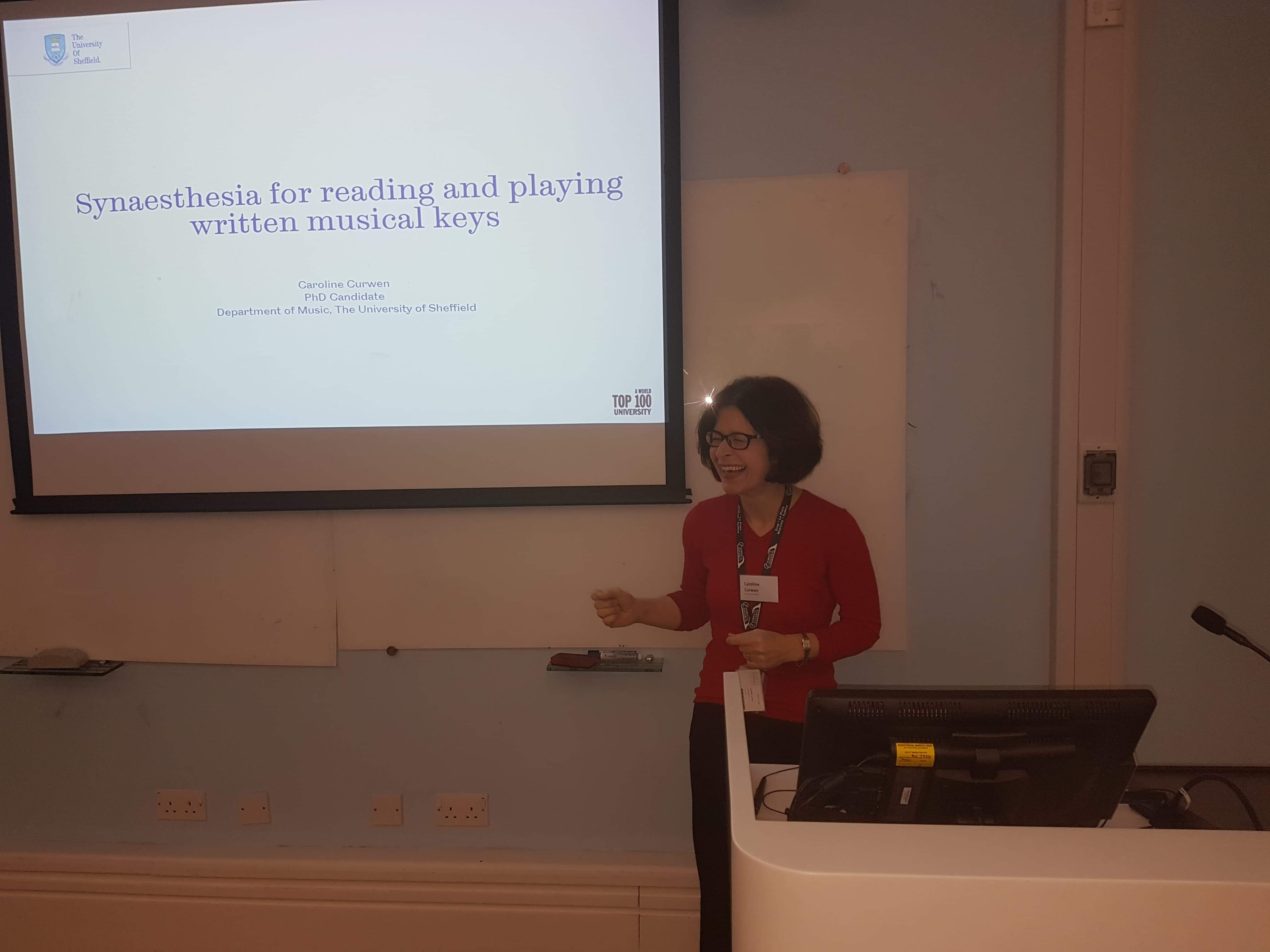
I will at some point attempt to remove the ‘alien’ floating above my right ear from this photo! -
I had the opportunity to present my paper Music-colour synaesthesia: concept, context and qualia in Graz this year at the IPMPC15/ESCOM10 conference.
 CAROLINE CURWEN